7 Best Reasons Vacuum Hoses Impact Engine Efficiency?

Time:2026-10-04 Author:Oliver
0%

Why do vacuum hoses impact engine efficiency? The answer begins with controlled airflow. These small rubber lines connect the intake manifold with systems such as the fuel-pressure regulator, brake booster, EVAP controls, and crankcase ventilation. When a hose cracks, collapses, or loosens, unmetered air can enter the engine. The air-fuel mixture then becomes lean, especially at idle and during light acceleration.

Automotive diagnostic author Tom Denton explains the principle clearly: “A vacuum leak is unmetered air entering the engine.” That short warning matters. A modern ECU can correct limited airflow errors, but it cannot repair a split hose. The result may include rough idle, hesitation, higher fuel consumption, misfire codes, or elevated emissions. The U.S. Environmental Protection Agency’s Automotive Trends Report connects real-world efficiency with engine control, emissions performance, and fuel economy. The Department of Energy’s Vehicle Technologies Office also identifies precise combustion control as a major efficiency factor. Vacuum integrity supports both.

This guide examines seven practical reasons vacuum hoses influence engine efficiency, from incorrect sensor readings to unstable fuel delivery. It will also consider inspection clues: a faint hiss near the intake, brittle rubber under a warm hood, or an idle speed that rises after spraying soapy water nearby. Not every symptom proves a hose fault. That is the uncomfortable part. Similar symptoms can come from sensors, gaskets, or software calibration. A careful diagnosis uses a smoke test, scan data, and visual inspection rather than guesswork. Even a small leak can waste fuel over thousands of kilometers, although the exact penalty depends on engine design, hose location, and driving conditions.
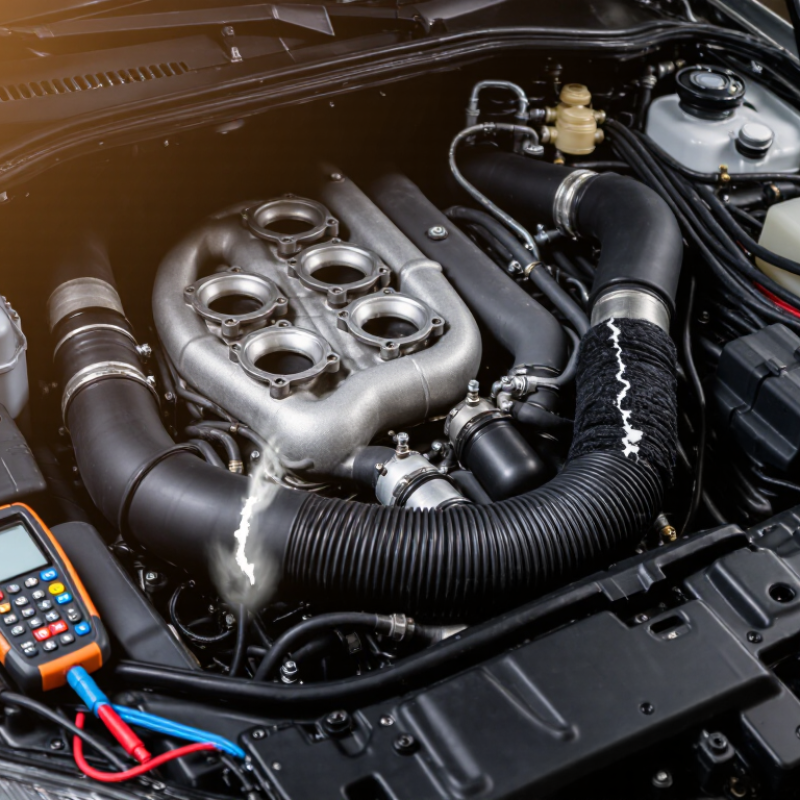
7 Best Reasons Vacuum Hoses Impact Engine Efficiency?

Vacuum Hoses and Their Role in Engine Airflow

Vacuum hoses quietly shape engine airflow. They carry intake pressure signals to control devices and sensors. A cracked hose admits unmetered air after the airflow sensor. The mixture then becomes lean, especially at idle. That creates the first three efficiency losses: unstable combustion, slower throttle response, and higher fuel correction.

The remaining effects are closely connected. A leak can raise idle speed, trigger misfires, reduce manifold vacuum, and increase exhaust emissions. Modern engine computers often compensate with short-term and long-term fuel trims. However, correction has limits.

SAE J1979 diagnostic data identifies fuel-trim changes as important evidence of airflow imbalance. The U.S. Environmental Protection Agency reported an average new-vehicle fuel economy of 27.1 miles per gallon in its 2023 Automotive Trends Report. That figure assumes a healthy air system, not a brittle hose beside a hot cylinder head.

In workshop inspections, I look for soft spots, surface cracks, loose clamps, and a faint hissing sound. A smoke test can reveal leaks that visual checks miss. Hose routing matters too; heat can harden rubber and vibration can open tiny splits. Replacing one hose may restore stable fuel trims, but not always. A contaminated sensor or sticking valve can produce similar symptoms. That is where diagnosis becomes less tidy. Pressure readings, scan-tool data, and service specifications should support the repair, rather than guesswork. Certain engines tolerate small leaks briefly. Their efficiency still suffers, quietly.

How Vacuum Leaks Disrupt the Air–Fuel Mixture

7 Best Reasons Vacuum Hoses Impact Engine Efficiency?

How Vacuum Leaks Disrupt the Air–Fuel Mixture

A vacuum hose controls air that the engine computer expects. When it cracks, extra air enters after the airflow sensor. The mixture becomes lean. Combustion may feel weak, uneven, or hesitant. At idle, the problem often sounds like a faint hiss near the intake manifold.

SAE J1979 identifies short-term and long-term fuel-trim data as key diagnostic measurements. In common service practice, positive fuel trim above 10% deserves investigation. Readings near 20% or higher often suggest unmetered air, although engine design changes the threshold. The U.S. Environmental Protection Agency’s OBD requirements also connect fuel-system monitoring with emissions-related faults. This makes scan data more reliable than guessing from engine noise alone.

I have misread this symptom before. A dirty airflow sensor can imitate a leaking hose. So can a weak purge valve. Compare fuel trims at idle and around 2,500 rpm. If the numbers improve significantly at higher speed, suspect a vacuum leak. A smoke test can reveal a split hose, loose connection, or brittle elbow. Check the small hose behind the throttle body, too. It is easy to overlook. Some technicians replace parts too quickly. That wastes money and may leave the real leak untouched. Accurate diagnosis needs physical inspection, scan data, and careful listening.

The Effects of Hose Condition on Idle and Acceleration

7 Best Reasons Vacuum Hoses Impact Engine Efficiency?

The Effects of Hose Condition on Idle and Acceleration

A vacuum hose can look acceptable while leaking underneath. Small cracks often appear near clamps, bends, and hot engine components. During idle, the engine depends on stable vacuum control. A loose or brittle hose may allow unmetered air into the intake system. The result can be a shaking idle, fluctuating engine speed, or an unexpected stall. Acceleration may feel worse. You might notice hesitation when pressing the pedal, especially after stopping at a traffic light. A lean air-fuel mixture can also increase combustion temperature and reduce efficiency.

Tips: Inspect hoses with the engine off and cool. Check for flattened sections, surface splits, and loose connections. A faint hissing sound can indicate a leak, but silence does not prove everything is sound. Use the vehicle service manual for the correct hose routing. Never guess at a connection. One misplaced line can create another fault.

A careful technician usually compares idle quality before and after testing each suspected hose. A vacuum gauge can provide useful evidence, but its reading needs proper interpretation. Other problems, including ignition faults or sensor errors, may produce similar symptoms. This is where diagnosis becomes less convenient. Replacing every hose may feel efficient, yet it can waste time and hide the original cause. I would recheck the repair after a short drive. The engine may idle smoothly, but acceleration can still reveal a remaining leak. Temperature changes matter too. A hose that seals when cold may soften and leak when the engine warms.

7 Best Reasons Vacuum Hoses Impact Engine Efficiency

The Effects of Hose Condition on Idle and Acceleration

A healthy warm-idle gasoline engine commonly shows approximately 18–22 inHg of manifold vacuum. Vacuum leaks reduce this reading, create unstable idle conditions, and can slow acceleration response. The values shown are representative diagnostic ranges rather than a universal specification; engine design, altitude, temperature, and measurement method can affect the result.

Why Vacuum Hoses Influence Fuel Economy and Emissions

Vacuum hoses influence fuel economy and emissions more than their simple appearance suggests. A cracked hose can admit unmeasured air into the intake system. The engine may then run lean, especially during idle or light acceleration. Its control system may add fuel to correct the mixture. Fuel consumption can rise gradually. The exhaust may also contain higher levels of unwanted pollutants. A loose connection can create similar symptoms. Not every rough idle comes from a hose, however. Faulty sensors and intake gaskets can produce comparable results.

During practical inspections, technicians should check hose softness, surface cracks, loose fittings, and flattened sections. Pay attention to areas near heat sources. Rubber can harden there, even when the outer surface looks acceptable. A leaking hose may cause hesitation, unstable idle speed, or an unusual hissing sound. These signs deserve measurement, not guesswork. A smoke test or vacuum reading can help confirm the leak’s location.

Tips: Inspect hoses when the engine is cool. Replace brittle sections with correctly sized tubing. Do not rely only on visual checks. Compare fuel economy before and after repairs. Keep notes, because small changes can be easy to overlook. A quick check is helpful, but it is not enough. Even a minor leak can affect combustion balance, though the effect may vary between engines.

7 Best Reasons Vacuum Hoses Impact Engine Efficiency? - Why Vacuum Hoses Influence Fuel Economy and Emissions

No. Vacuum-Hose Factor Typical Hose Problem Effect on Engine Operation Fuel-Economy and Emissions Impact Useful Diagnostic Clues Recommended Action
1 Unmetered air entering the intake Cracks, loose connections, hardened elbows, or disconnected vacuum lines after the airflow sensor. Extra air bypasses the normal measurement point, creating a lean air-fuel mixture and unstable idle. The control system may add fuel, increasing fuel consumption. Lean combustion can raise combustion temperature and nitrogen-oxide emissions. Positive short- and long-term fuel trims, rough idle, hissing sounds, or a vacuum reading below the vehicle’s specified range. Inspect every hose and fitting; repair leaks and verify fuel-trim readings after the engine reaches operating temperature.
2 Incorrect manifold-pressure information A restricted, split, or moisture-contaminated hose connected to the manifold-pressure sensor. The sensor receives a delayed or inaccurate pressure signal, affecting load calculation and ignition timing. Incorrect load data can cause excessive fueling, weak acceleration, unstable combustion, and higher carbon-monoxide or hydrocarbon emissions. Unusual sensor readings, hesitation, hard starting, poor idle quality, or diagnostic trouble codes related to manifold pressure. Use a pressure or scan-tool comparison test and replace hoses that are blocked, soft, brittle, or internally collapsed.
3 Crankcase ventilation control A blocked ventilation hose, split line, or incorrectly connected check valve. Crankcase pressure becomes too high or too low, disturbing idle control and allowing oil vapor or excess air into the intake. Poor ventilation can increase oil consumption, deposits, hydrocarbons, and fuel use while reducing combustion consistency. Oil seepage, whistling, unstable idle, excessive crankcase pressure, or oil residue near hose connections. Check hose routing, flow direction, valve operation, and connection sealing; clean or replace restricted components.
4 Fuel-pressure regulation A leaking or disconnected hose between the intake manifold and a vacuum-referenced fuel-pressure regulator. Fuel pressure may not respond correctly to engine load, causing an overly rich or lean mixture. An overly rich mixture wastes fuel and increases carbon-monoxide emissions; a lean mixture may increase misfires and nitrogen-oxide emissions. Fuel odor in the hose, abnormal fuel-pressure readings, black exhaust smoke, hard starting, or strongly negative fuel trims. Inspect the hose for fuel contamination and test fuel pressure at idle and under load according to the vehicle service specification.
5 Evaporative-emissions vapor control A cracked vapor hose, incorrect purge connection, or leaking control line. Fuel vapors may enter the intake at the wrong time or escape before controlled combustion. Uncontrolled vapor flow can cause hard starting, rough idle, increased hydrocarbon emissions, and reduced fuel efficiency. Fuel smell, difficult starting after refueling, purge-flow faults, or an emissions-test failure. Perform a smoke test, inspect vapor-line routing, and confirm that the purge valve seals when it should be closed.
6 Exhaust-gas recirculation control A leaking, blocked, or incorrectly routed vacuum line controlling exhaust-gas recirculation. Too much recirculation at idle can cause stalling, while insufficient recirculation under load can increase combustion temperature. Incorrect operation can reduce efficiency, cause hesitation, and increase nitrogen-oxide emissions during acceleration or cruising. Rough idle, pinging under load, hesitation, control-system codes, or no change during a controlled actuator test. Verify hose routing and actuator movement; repair leaks and remove deposits only when permitted by the service procedure.
7 Vacuum-operated boost or airflow controls Leaks, kinks, or weak connections in hoses controlling a turbocharger actuator, intake flap, or other airflow device. Airflow and boost may not match the commanded level, forcing the engine to work harder or enter a reduced-power strategy. Poor boost control can reduce fuel economy, increase exhaust temperature, and raise smoke or hydrocarbon emissions in compression-ignition applications. Low power, slow acceleration, inconsistent boost, actuator-movement faults, or abnormal pressure readings under load. Inspect the complete control circuit, test vacuum-holding ability, and confirm actuator travel with an approved test procedure.

Reference note: Actual vacuum levels, fuel-trim limits, pressure values, and diagnostic procedures vary by engine design. A warm, healthy naturally aspirated engine often shows approximately 17–22 inHg of steady manifold vacuum at idle, but the manufacturer’s service specification should always take priority.

How Inspection and Replacement Restore Engine Efficiency

Vacuum hoses quietly influence seven engine functions: air-fuel control, idle stability, ignition timing, exhaust-gas circulation, crankcase ventilation, fuel-vapor control, and boost regulation. A split hose can admit unmetered air, creating a lean mixture. The engine may then hunt at idle, hesitate during acceleration, or trigger a fault code. Cracked rubber often feels hard near hot fittings. Sometimes, it only leaks when flexed.

Inspection should begin with a cold visual check. Look for brittle surfaces, loose clamps, oil-softened sections, and collapsed bends. A smoke test can reveal leaks around the intake manifold and hidden connectors.

The U.S. Department of Energy states that correcting a serious maintenance problem, such as a faulty oxygen sensor, may improve fuel economy by up to 40% (FuelEconomy.gov, “Gas Mileage Tips”).

That figure does not apply directly to every hose, but it shows how control faults can waste fuel. SAE technical guidance also links unmetered air and unstable intake pressure with inaccurate engine control calculations.

Replacement should use the correct heat-resistant hose and routing. Do not stretch it. A small routing mistake can create a second leak.

Afterward, technicians should clear codes only after testing, then verify idle speed, fuel trims, and road performance. I have seen engines run smoother after a simple hose change, although replacing parts without confirming the leak remains poor practice.

FAQS

What does a vacuum hose do in an engine?

It directs controlled air signals to engine systems. These signals support mixture control, idle stability, timing, ventilation, and vapor management.

How can a cracked hose affect the air–fuel mixture?

A crack may admit unmeasured air after the airflow sensor. The mixture becomes lean, causing hesitation, uneven combustion, or unstable idling.

What symptoms suggest a vacuum leak?

Listen for a faint hiss near the intake manifold. The engine may hunt at idle, hesitate during acceleration, or display a fault code.

Can fuel-trim readings help confirm a vacuum leak?

Yes. Positive fuel trim above 10% deserves investigation. Readings near 20% may suggest unmeasured air, depending on engine design.

Why should fuel trims be compared at different engine speeds?

Compare readings at idle and around 2,500 rpm. If trims improve greatly at higher speed, a vacuum leak becomes more likely.

What physical signs should an inspection find?

Check for brittle rubber, loose clamps, oil-softened sections, and collapsed bends. Some hoses leak only when flexed. Check cold.

Which testing method can reveal hidden hose leaks?

A smoke test can expose split hoses, loose connections, and hidden connector leaks. It can also find problems near the intake manifold.

Can another faulty part imitate a vacuum leak?

Yes. A dirty airflow sensor or weak purge valve can create similar symptoms. I have misread this before. Guessing costs money.

How should a replacement hose be installed?

Use the correct heat-resistant hose and original routing. Do not stretch it. A small routing error can create another leak.

What should be checked after replacing a hose?

Test before clearing codes. Verify idle speed, fuel trims, and road performance. A smoother engine is useful evidence, but not complete proof.

Conclusion

Vacuum hoses play a vital role in controlling the airflow and pressure signals that help an engine maintain the correct air–fuel mixture. Why do vacuum hoses impact engine efficiency? When these hoses are cracked, loose, brittle, or blocked, unwanted air can enter the system and disrupt engine balance. This may cause rough idling, hesitation during acceleration, reduced power, and inconsistent performance because the engine can no longer respond accurately to changing driving conditions.

Damaged vacuum hoses can also increase fuel consumption and contribute to higher emissions, as the engine may compensate for an incorrect mixture by using more fuel. Regular inspection can reveal small cracks, soft sections, loose connections, or signs of heat damage before they create larger problems. Replacing worn hoses and securing their connections helps restore stable airflow, smoother operation, better acceleration, improved fuel economy, and more efficient overall engine performance.

Oliver

Oliver

Oliver is a seasoned marketing professional with a wealth of expertise in driving brand awareness and engagement. With a deep understanding of our company's product offerings, he consistently delivers high-quality content that enriches our professional blog. His insights not only shed light on......